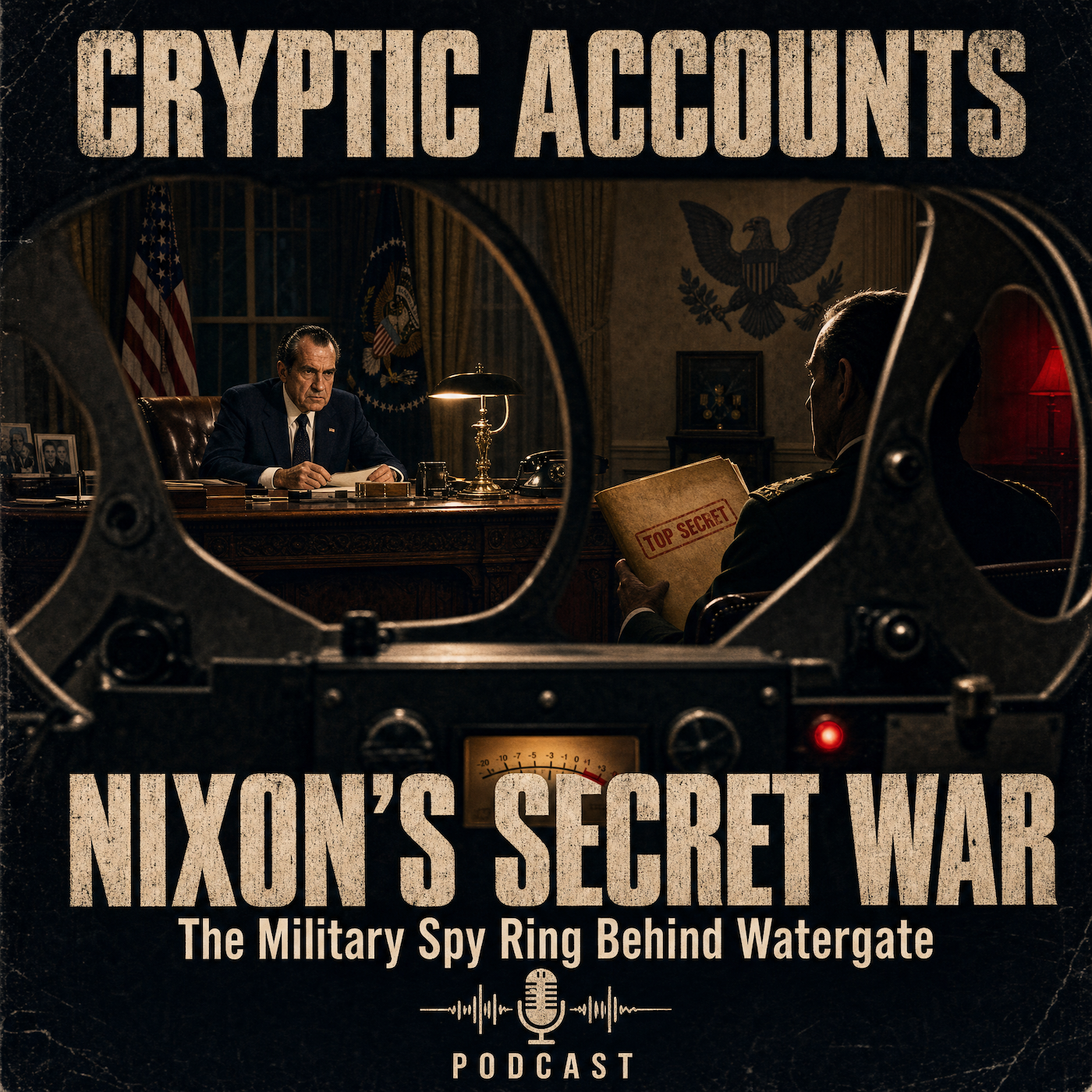
Everyone knows the Watergate story.
Five men arrested inside the Democratic National Committee headquarters at the Watergate complex. A cover-up that climbs all the way into the Oval Office. Secret White House tapes. A president forced to resign in disgrace rather than face almost certain impeachment and removal. It is the single most taught political scandal in modern American history — the moment the constitutional system is said to have worked.
Here is the part that almost never receives equal weight in that telling: while the Watergate drama was unfolding, the President of the United States was also being systematically spied on by his own military. Not by political opponents in Congress. Not by the press. By the Joint Chiefs of Staff. They used a Navy stenographer assigned to the National Security Council staff to steal thousands of classified documents — from briefcases, burn bags, desks, and “eyes only” files — and feed them up the chain of command to the Chairman of the Joint Chiefs himself.
That is not a fringe theory. It is documented by the yeoman’s own sworn testimony and polygraph examinations, by contemporaneous White House tape recordings of the discovery, by the partial admissions of the military officers involved, and by the investigative record that followed. It remains one of the most under-taught constitutional crises of the modern presidency.
The question is not whether Richard Nixon committed crimes. The record shows that he did. The deeper question is why the public received one set of documented abuses in high definition and the other largely in footnotes — and what that selective focus reveals about how power manages its own history.
On August 15, 2026, Daily Wire released the seventh episode of Matt Walsh’s Real History series, titled “The Real History of Watergate.” Its promotional framing is direct: the public was taught that the cover-up was worse than the crime, but “thousands of pages of declassified documents and sworn testimony tell a totally different story — one of intrigue, sabotage, betrayal, and deep state subversion.”
That is a legitimate reason to reopen the file. It is not, by itself, a complete historical conclusion. So tonight we are going to put both the standard narrative and the suppressed parallel narrative against the actual evidence and see what holds under scrutiny.
I am not going to claim that Nixon was an innocent man framed by pure forces of light. The break-in, the hush money, the obstruction of justice, and the smoking-gun tape are real. We will also not treat the military’s espionage operation against the civilian command as a minor bureaucratic irregularity. Both things happened. The public was given a simplified version of only one of them. That imbalance is itself part of the story worth examining.
The Standard Narrative — What the Record Actually Shows
On the night of June 17, 1972, five men were arrested inside the offices of the Democratic National Committee at the Watergate complex in Washington, D.C. They were carrying electronic surveillance equipment and cameras. Two of the men had direct financial and operational ties to the Committee to Re-Elect the President, commonly known as CREEP. The operation was supervised by G. Gordon Liddy, a former FBI agent then working for the re-election committee, and involved E. Howard Hunt, a former CIA officer who had also served in the White House.
The break-in was not an isolated freelance crime. It belonged to a broader pattern of political intelligence and dirty-tricks activity. The same circle of operatives had already participated in the September 1971 break-in at the office of Lewis Fielding, the psychiatrist of Daniel Ellsberg, the man who had leaked the Pentagon Papers. That earlier operation was an attempt to obtain damaging personal material that could be used against Ellsberg. The unit responsible for stopping leaks of classified information and for conducting these operations became known, informally, as the Plumbers.
After the Watergate arrests, a cover-up began almost immediately. Money was raised and delivered to the burglars and their families. False statements were made to investigators. And on June 23, 1972 — only six days after the break-in — President Nixon met with his chief of staff, H.R. Haldeman, in the Oval Office. The conversation was captured by the White House taping system. On that recording, later called the “smoking gun,” Nixon and Haldeman discuss having the Central Intelligence Agency instruct the Federal Bureau of Investigation to limit its investigation. The stated rationale was national security and the risk of exposing old CIA connections related to the Bay of Pigs operation. The actual purpose was to prevent the money trail from reaching the re-election committee and, ultimately, the White House.
When that tape was finally released to the public in early August 1974, after the Supreme Court rejected Nixon’s claim of absolute executive privilege in United States v. Nixon, the remaining political support for the president in Congress collapsed. Nixon resigned on August 9, 1974. He remains the only American president to resign from office. A month later, President Gerald Ford issued a full and unconditional pardon covering any crimes Nixon “committed or may have committed” while serving as president. That pardon is one reason Nixon never faced a criminal trial, and one reason the full documentary record emerged only gradually over the following decades.
Other elements of the standard record include James McCord’s March 1973 letter to Judge John Sirica. McCord, one of the convicted burglars, alleged that perjury had been committed during the trial and that higher-level participants in the operation had gone unindicted. The letter is widely credited with cracking the cover-up open and leading to further testimony. There is also the 18½-minute gap on one of the White House tapes — a stretch of conversation erased under circumstances that have never been fully explained. Technical examinations concluded that the erasure was the product of multiple separate manual operations rather than a single accidental depression of a foot pedal, as Nixon’s secretary Rose Mary Woods had claimed.
The broader sequence included the Senate Watergate hearings in 1973, the revelation of the White House taping system by Alexander Butterfield, the Saturday Night Massacre in October 1973 (when Nixon ordered the firing of special prosecutor Archibald Cox and both the Attorney General and Deputy Attorney General resigned rather than carry out the order), and the eventual approval of articles of impeachment by the House Judiciary Committee in 1974.
That record is solid. The crimes happened. The obstruction of justice is on tape in the president’s own voice. That is the floor of the story, not the ceiling.
The Parallel Scandal — The Military Spy Ring Against the White House
Now the parallel story that rarely receives comparable attention.
In September 1970, Navy Yeoman First Class Charles E. Radford was assigned to the military liaison office that connected the Joint Chiefs of Staff to the National Security Council staff headed by Henry Kissinger. Radford was a skilled stenographer and clerk. His position gave him routine access to highly sensitive material and allowed him to travel with senior officials, including Kissinger and his deputy at the time, Brigadier General Alexander Haig.
According to Radford’s later testimony under polygraph examination and in closed and open congressional sessions, he was instructed by his superior officers — first Rear Admiral Rembrandt C. Robinson and later Rear Admiral Robert O. Welander — to keep his eyes open for any information that might be useful to the Joint Chiefs. Over the following thirteen to fifteen months he carried out that instruction systematically. He later estimated that he had taken approximately five thousand documents.
His methods were practical and continuous. He made extra photocopies of documents he was asked to handle or courier. He retrieved drafts, carbons, and discarded papers from burn bags that were supposed to be destroyed. He went through the briefcases of Kissinger and Haig while the men slept during long overseas flights. He collected “eyes only” material that was intended solely for the President or for Kissinger. Among the material that passed through his hands were notes and reports from Kissinger’s secret July 1971 trip to China (including accounts of conversations with Zhou Enlai), internal deliberations concerning the 1971 India-Pakistan war, documents related to the Strategic Arms Limitation Talks, and sensitive reporting on Vietnam and Cambodia policy.
The documents moved up a clear chain. Radford delivered them to Robinson or Welander. Those admirals, in turn, passed selected material to Admiral Thomas H. Moorer, the Chairman of the Joint Chiefs of Staff. In some instances the material also reached other senior officers, including Admiral Elmo Zumwalt, the Chief of Naval Operations.
This was not informal information-sharing or bureaucratic overreach. It was an unauthorized intelligence collection operation run by the uniformed military leadership against the civilian national-security apparatus during an ongoing war. The Joint Chiefs were acting because they distrusted the direction of Nixon and Kissinger’s foreign policy — particularly the opening to China, the pursuit of détente with the Soviet Union, and the handling of the Vietnam conflict. They created their own pipeline to monitor decisions from which they believed they were being excluded.
The operation was exposed in December 1971. Syndicated columnist Jack Anderson published a series of articles containing highly classified details of U.S. policy deliberations during the India-Pakistan crisis. The specificity of the material indicated a source inside the National Security Council. White House investigators, including John Ehrlichman and members of the Plumbers unit, began tracing the leak. In the course of that investigation they uncovered Radford’s broader pattern of document theft.
When Ehrlichman reported the findings to Nixon, the conversation was recorded by the White House taping system. Nixon’s reaction is on the record. He described the military’s conduct as “a federal offense of the highest order.” He considered pursuing criminal charges against Admiral Moorer for espionage. His Attorney General and other senior advisers argued strongly against a public prosecution or court-martial. They warned that a public spectacle involving the Chairman of the Joint Chiefs of Staff in the middle of the Vietnam War would damage public confidence in the military and in the government more broadly.
The decision was made to contain the matter rather than prosecute it. Radford was transferred out of the White House. Moorer was not charged. In 1972 Nixon reappointed him to a second two-year term as Chairman of the Joint Chiefs. The story did not receive sustained public examination until early 1974, when it surfaced during Senate Armed Services Committee hearings connected to the wider Watergate investigations. Even then the treatment remained limited. Moorer acknowledged receiving some material but minimized the systematic nature of the collection. The deeper White House tape recordings of the December 1971 discussions and the internal investigative memoranda became more fully available to researchers only in later decades.
How the Two Stories Intersect
The discovery of the military spy ring in December 1971 did not cause the Watergate break-in. Causation in these events is more complex than a single straight line. But the discovery did shape the institutional atmosphere and the threat perception inside the White House in the months that followed.
The administration had just learned that its own senior military leadership was running an intelligence operation against the National Security Council. That revelation reinforced an already intense preoccupation with unauthorized disclosures of information. The same investigative group that had uncovered Radford — the Plumbers — continued and expanded its work. Within months, methods and personnel associated with that unit were involved in the political intelligence operations that culminated in the Watergate break-in.
This sequence does not excuse the crimes that followed. It does help explain the intensity of the White House response to subsequent leaks and the willingness to cross legal boundaries in order to reassert control over information. An administration that had already experienced betrayal from inside the Pentagon was primed to treat every new disclosure as a potential existential threat. The result was a self-reinforcing cycle of suspicion, illegal surveillance, and obstruction that ultimately destroyed the presidency.
Both sides of the institutional conflict were operating according to rules that had little to do with transparent democratic accountability. The military ran an unauthorized collection program against the civilian command structure. The White House responded with its own illegal intelligence activities and a cover-up that reached the president. The public, however, received a morality play that focused almost exclusively on one set of actors and one set of crimes.
The Problem of Selective Memory
This is where the episode moves beyond a simple recounting of two scandals and into the question of how historical memory is shaped.
The Watergate crimes were dramatic, captured on tape, and produced a clear narrative of presidential wrongdoing followed by constitutional process. That narrative was relatively easy to teach, easy to dramatize in film and television, and politically useful to a wide range of institutions that preferred a story of one corrupt president checked by a vigilant system.
The Moorer-Radford affair was also real, also documented by multiple forms of evidence, and also constituted a direct challenge to the principle of civilian control of the military during wartime. It was harder to package. It implicated the uniformed leadership of the armed forces. It raised uncomfortable questions about institutional self-protection across several centers of power at once. And it did not fit cleanly into a story of a single rogue president versus the forces of accountability.
As a result, one set of documented abuses became the defining political morality tale of a generation. The other became a specialized footnote known primarily to historians, researchers, and those willing to dig into the primary record. That imbalance is itself evidence of how power manages its own history. Institutions protect themselves. Narratives that threaten multiple power centers simultaneously tend to be narrowed, minimized, or allowed to fade.
The March 31, 2025 opening of previously classified materials at the Nixon Library added further National Security Council country files, arms-control records, China and Vietnam negotiation documents, and Alexander Haig files. It was not a Watergate-specific document dump, and it does not overturn the criminal record of the cover-up. What it does reinforce is that the archival picture continues to expand long after the standard public narrative was locked in place, and that the version of events most people absorbed was never as complete as the textbooks suggested.
Closing
The White House tapes do not lie. The grand-jury testimony and the contemporaneous investigative record do not lie. Richard Nixon obstructed justice, and the constitutional system ultimately removed him from office for it. That portion of the history is solid and should not be wished away or minimized.
But the fuller record shows something more complicated and more revealing about how power actually functions. While the White House was committing its own crimes, the nation’s top military officers were running an intelligence operation against the civilian national-security apparatus. Both of those things are true at the same time. The public was given a simplified, high-resolution version of only one of them.
The familiar summary — “the cover-up was worse than the crime” — was always a partial sentence. The more complete version is this: the cover-up was worse than the crime, and the crime occurred inside an institutional environment that had already been lying to itself, spying on itself, and protecting its own equities in multiple directions long before any Watergate document needed to be shredded or any tape needed to be erased.
That brings us to the questions that matter most.
Who benefited from the selective focus?
Several overlapping interests did.
Political opponents of Nixon gained an unambiguous moral and political victory that could be taught as a clean story of presidential criminality checked by the system. The national-security bureaucracy and the military leadership gained something quieter but more durable: the relative absence of sustained public scrutiny of their own unauthorized intelligence operation against the civilian command. Media and academic institutions gained a coherent, dramatic narrative that fit existing frameworks of accountability and that did not require them to examine the more diffuse problem of institutional self-protection across multiple power centers. Later political actors across the spectrum gained a permanent reference point — “another Watergate” — that could be invoked against almost any subsequent scandal while leaving the harder questions about systemic surveillance and mutual distrust largely untouched.
No single cabal had to coordinate this outcome. The incentives simply aligned. A story that concentrated blame on one president and one White House was useful to more institutions than a story that implicated the military chain of command, the civilian national-security apparatus, and the political class at the same time.
What does the imbalance tell us about the incentives of the institutions that write, teach, and preserve the official version of events?
It tells us that historical memory is not a neutral mirror. It is shaped by the practical needs of the institutions that produce it. Simple stories of individual presidential failure are easier to teach, easier to dramatize, and safer for the legitimacy of the broader system than complex stories of mutual surveillance and institutional survival. Narratives that threaten several power centers simultaneously tend to be narrowed, minimized, or allowed to fade into specialized footnotes. Narratives that isolate wrongdoing in a single office or a single administration are more readily absorbed into civic education and public memory.
This does not require a conspiracy theory. It requires only an understanding of institutional self-interest. Organizations protect their own legitimacy. When the full record implicates more than one of them, the version that survives in general circulation is often the one that does the least damage to the largest number of stakeholders.
The result is a public understanding of Watergate that is accurate about Nixon’s crimes and incomplete about the environment in which those crimes occurred. The military spy ring against the National Security Council does not erase the smoking-gun tape. The smoking-gun tape does not erase the military spy ring. Both belong in any serious account. The fact that one has dominated public memory while the other has not is itself evidence of how power writes, and limits, its own history.